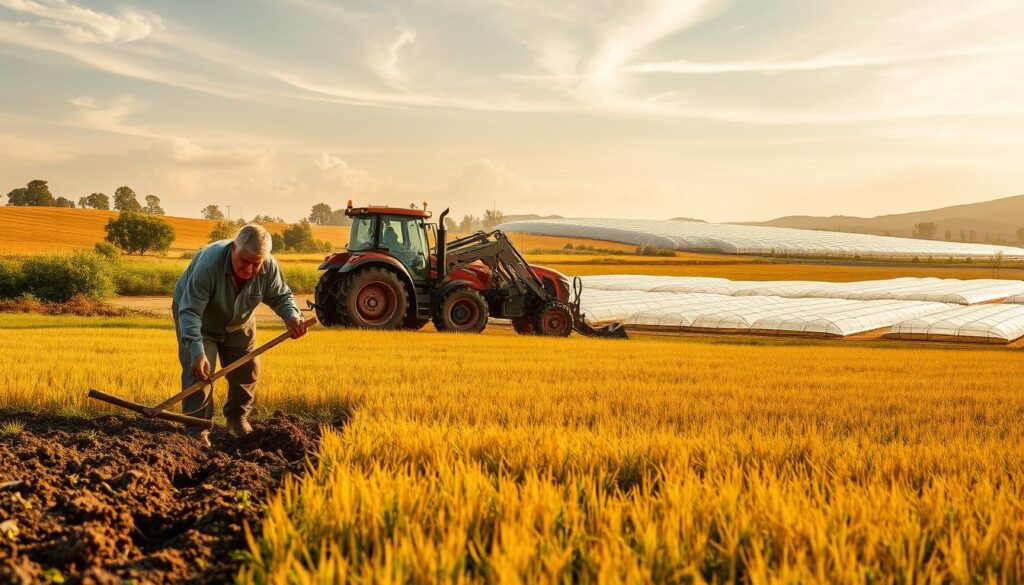
The way we farm has undergone significant changes over the years, driven by advancements in agricultural technology. From simple, manual tools to complex machinery and precision farming techniques, the evolution of farming tools has transformed the agricultural landscape.
The importance of farming tools cannot be overstated, as they directly impact crop yields, efficiency, and the overall sustainability of farming practices. As the global population continues to grow, the need for innovative and effective farming solutions becomes increasingly pressing.
The contrast between traditional farming methods and modern farming techniques is stark, with each having its own set of advantages and challenges. Understanding the differences between these approaches is crucial for farmers, policymakers, and anyone interested in the future of agriculture.
Key Takeaways
- The evolution of farming tools has significantly impacted agricultural productivity.
- Modern farming techniques offer improved efficiency and crop yields.
- Understanding the differences between traditional and modern farming is crucial for the future of agriculture.
- Agricultural technology continues to drive innovation in farming practices.
- The choice of farming tools affects the sustainability of farming methods.
The Evolution of Agricultural Tools
From simple hand tools to complex machinery, the evolution of agricultural tools has transformed farming. This transformation has not only improved the efficiency of farming operations but also increased productivity and reduced labor requirements.
From Hand Tools to High-Tech Equipment
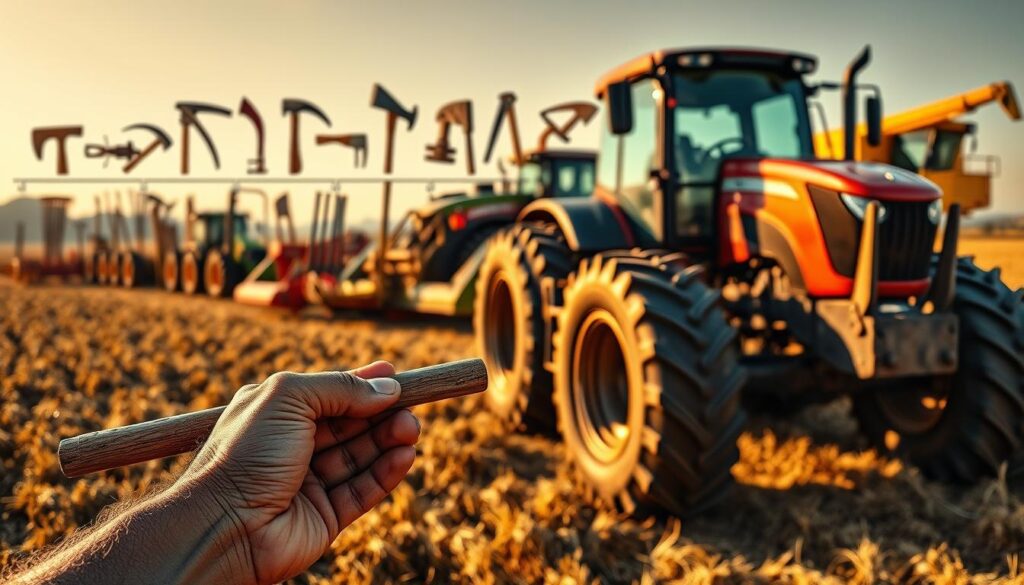
The history of agricultural tools began with basic hand-operated implements. Over time, these tools evolved into more sophisticated equipment, such as mechanized tractors and plows. Today, farming incorporates high-tech equipment, including GPS-guided tractors and drones, which have further enhanced farming practices.
The Importance of Tool Selection in Farming
Selecting the right tools for farming is crucial for optimizing efficiency, productivity, and environmental sustainability. The choice of tools can significantly impact farm operations, from planting and harvesting to irrigation and crop management.
| Tool Type | Efficiency | Productivity |
|---|---|---|
| Hand Tools | Low | Limited |
| Mechanized Equipment | Medium | Moderate |
| High-Tech Equipment | High | High |
The table above illustrates the varying levels of efficiency and productivity associated with different types of farming tools. As farming continues to evolve, the importance of selecting the appropriate tools cannot be overstated.
Traditional Farming Tools – An Overview
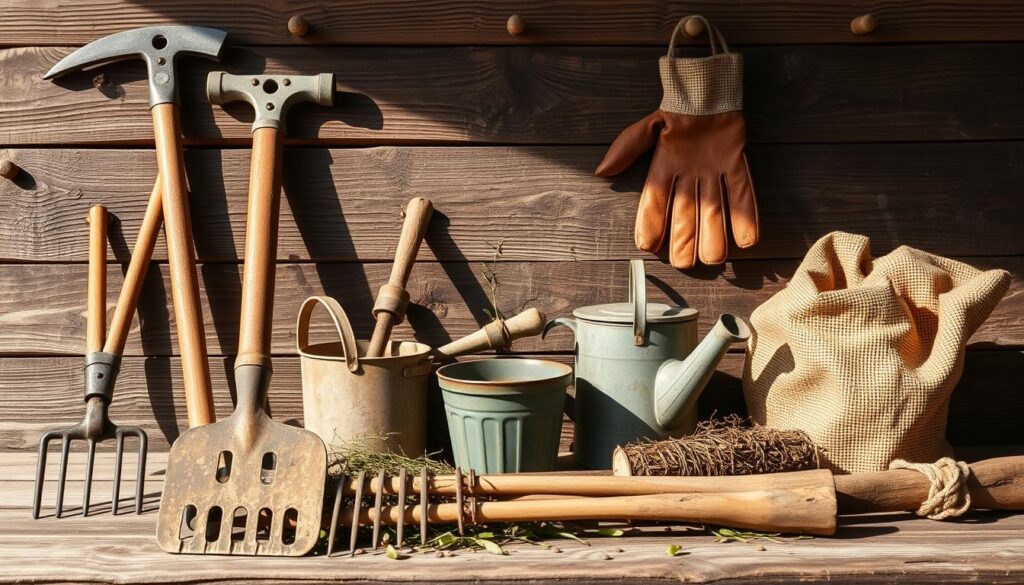
For generations, farmers have relied on traditional tools to work the land, from simple hand-operated implements to more complex animal-powered equipment. These tools have been fundamental to agricultural practices, enabling farmers to cultivate, plant, and harvest their crops efficiently.
Hand-Operated Tools
Hand-operated tools are the most basic form of traditional farming equipment. They require manual labor but are effective for small-scale farming and specific tasks.
Plows and Tillers
Plows and tillers are crucial for preparing the soil for planting. They help in turning over the soil, removing weeds, and aerating the ground. These tools have been used for centuries and are still valuable in modern farming for their simplicity and effectiveness.
Sickles and Scythes
Sickles and scythes are used for harvesting crops. A sickle is a curved blade used to cut grain or other crops, while a scythe is a longer, curved blade mounted on a handle, used for cutting larger areas of crops. These tools require skill and physical effort but are essential for certain types of crops.
Animal-Powered Equipment
As farming evolved, so did the tools. Animal-powered equipment marked a significant advancement, allowing farmers to cultivate larger areas with less manual labor.
Ox-Drawn Plows
Ox-drawn plows were a significant innovation, enabling farmers to till larger areas more efficiently than with hand tools alone. The use of oxen or other draft animals to pull plows revolutionized farming by increasing productivity.
Horse-Drawn Harvesters
Horse-drawn harvesters further increased the efficiency of farming by allowing for the mechanized harvesting of crops. Although more complex than hand tools, these were still considered traditional, as they relied on animal power rather than mechanized engines.
These traditional farming tools have played a vital role in agricultural practices, representing a blend of simplicity, effectiveness, and cultural heritage. Understanding their use and significance is crucial for appreciating the evolution of farming techniques.
The Cultural Significance of Traditional Farming Implements
Across the globe, traditional farming implements are a testament to the rich agricultural heritage of various cultures. These tools not only reflect the ingenuity and resourcefulness of our ancestors but also play a significant role in preserving cultural identity.
Heritage and Knowledge Transfer
Traditional farming implements are more than just tools; they are vessels of cultural heritage and knowledge. The passing down of these implements from one generation to the next is a practice that reinforces community bonds and preserves traditional farming techniques. This transfer of knowledge is crucial for sustainable agriculture, as it ensures that farming practices are adapted to local conditions, promoting environmental stewardship.
Regional Variations in Traditional Tools
The diversity in traditional farming implements across different regions highlights the adaptability and creativity of farming communities. For instance, the use of specific types of plows, irrigation systems, and harvesting tools varies significantly from one region to another, reflecting local climate conditions, soil types, and cultural practices.
| Region | Traditional Tool | Use |
|---|---|---|
| Asia | Water Buffalo-Pulled Plow | Paddy Field Preparation |
| Africa | Hoe | Weeding and Soil Preparation |
| Europe | Wooden Plow | Soil Tillage |
The cultural significance of these traditional farming implements lies in their representation of agricultural heritage and their role in maintaining diverse farming techniques. As we move towards more modern farming practices, it’s essential to preserve the knowledge and cultural values embedded in these traditional tools.
Modern Farming Tools – Technological Advancements
Modern farming tools have brought about a new era in agricultural productivity and efficiency. The integration of technology in farming has transformed traditional practices, making them more sophisticated and effective.
Mechanized Equipment
Mechanized equipment has been a cornerstone in modernizing farming practices. This category includes a range of machinery that has significantly reduced manual labor and increased productivity.
Tractors and Attachments
Tractors are versatile machines used for various farming tasks, from plowing to hauling. They can be equipped with different attachments such as plows, seed drills, and cultivators, making them indispensable for many farming operations.
Combine Harvesters
Combine harvesters are complex machines that combine the tasks of reaping, threshing, and winnowing. They are particularly useful for grain crops, significantly reducing the time and labor required for harvesting.
Precision Agriculture Tools
Precision agriculture involves using advanced technology to optimize crop yields and reduce waste. This approach relies on various tools and technologies to achieve precision in farming practices.
GPS-Guided Systems
GPS-guided systems enable farmers to navigate their equipment with high accuracy, reducing overlap and ensuring that every part of the field is treated appropriately. This technology improves efficiency and reduces input costs.
Drones and Sensors
Drones equipped with sensors and cameras provide valuable data on crop health, soil moisture, and other factors. This information allows farmers to make informed decisions, applying inputs more precisely and improving overall crop management.
| Tool | Description | Benefits |
|---|---|---|
| Tractors | Versatile machines for various farming tasks | Increased productivity, reduced labor |
| Combine Harvesters | Complex machines for reaping, threshing, and winnowing | Reduced time and labor for harvesting |
| GPS-Guided Systems | Navigation systems for precise equipment control | Improved efficiency, reduced input costs |
| Drones and Sensors | Data collection tools for crop and soil monitoring | Informed decision-making, precise input application |
The adoption of modern farming tools represents a significant step forward in agricultural practices. By leveraging mechanized equipment and precision agriculture tools, farmers can enhance productivity, reduce environmental impact, and improve their bottom line.
Digital Revolution in Agriculture
The advent of digital tools in agriculture marks a new era in farming, enhancing efficiency and productivity. This digital revolution is transforming the way farmers work, making it possible to manage farms more effectively and sustainably.
Farm Management Software
Farm management software is a crucial component of modern agriculture. It enables farmers to track and manage various aspects of their operations, from crop health to financial records. Granular’s farm management software, for example, offers a comprehensive platform for farmers to plan, execute, and monitor their farming activities.
IoT Applications in Farming
The Internet of Things (IoT) is playing a significant role in agricultural innovation. IoT devices can monitor soil moisture, temperature, and crop health in real-time, allowing for data-driven decision-making. Smart farming practices, facilitated by IoT, are helping farmers optimize resource use and reduce waste.
Automated Irrigation Systems
Automated irrigation systems are another key aspect of the digital revolution in agriculture. These systems use sensors and weather data to optimize water application, reducing waste and ensuring that crops receive the right amount of moisture. By integrating farm equipment with automated irrigation systems, farmers can significantly improve crop yields and reduce their environmental footprint.
In conclusion, the digital revolution in agriculture is bringing about significant changes in farming practices, driven by technologies such as farm management software, IoT applications, and automated irrigation systems. As these technologies continue to evolve, they are likely to play an increasingly important role in shaping the future of agriculture.
Traditional vs. Modern Farming Tools – A Comparison
In the world of agriculture, the shift from traditional to modern farming tools is a significant consideration for farmers. The choice between these two categories depends on various factors that impact farm productivity and sustainability.
Efficiency and Productivity
Modern farming tools have significantly improved efficiency and productivity on farms. Mechanized equipment and precision agriculture tools allow for faster and more accurate farming practices. In contrast, traditional tools, while effective, often require more labor and time.
- Modern tools increase crop yields and reduce waste.
- Traditional tools provide a more personal touch and can be more cost-effective for small farms.
Environmental Impact
The environmental impact of farming tools is a crucial consideration. Modern tools, while often more efficient, can have a larger carbon footprint due to their reliance on fossil fuels. Traditional tools, on the other hand, tend to be more environmentally friendly.
Precision agriculture can help reduce the environmental impact by optimizing resource use.
Cost Considerations
The cost of farming tools is a significant factor for farmers. While modern tools are often more expensive to purchase and maintain, they can lead to long-term savings through increased efficiency. Traditional tools, being less expensive, can be more accessible to small-scale farmers.
Labor Requirements
Labor requirements vary significantly between traditional and modern farming tools. Modern tools often reduce the need for manual labor, while traditional tools require more human effort.
A balanced approach, combining both traditional and modern tools, can help farmers optimize their labor resources.
Comprehensive Comparison Table
As farming practices continue to evolve, understanding the differences between traditional and modern tools is becoming increasingly important. The following comparison highlights key aspects of both traditional and modern farming tools.
Performance Metrics
When evaluating farm equipment, performance is a critical factor. Modern agricultural technology often offers higher efficiency and productivity compared to traditional methods. For instance, precision agriculture tools can significantly reduce waste and improve crop yields.
“The use of modern farm equipment has revolutionized the way we farm, allowing for more precise and efficient farming practices,” notes an agricultural expert.
Initial Investment and Maintenance Costs
The initial investment for modern farming tools can be substantial, but they often lead to long-term cost savings. In contrast, traditional tools typically require less upfront investment but may have higher labor costs. A comparison table summarizing these costs can help farmers make informed decisions.
| Tool Type | Initial Investment | Maintenance Costs |
|---|---|---|
| Traditional | Low | High |
| Modern | High | Low |
Skill Requirements
The skill level required to operate modern farm equipment is generally higher than that for traditional tools. Farmers need training to effectively use agricultural technology, including precision farming tools and automated irrigation systems.
Impact on Farmers and Agricultural Communities
Modern farming tools are revolutionizing agricultural practices, affecting both farmers and the broader rural communities. As agriculture becomes more mechanized and technologically advanced, significant changes are occurring in various aspects of farming and rural life.
Changes in Farm Labor Dynamics
The introduction of modern farming equipment has led to a reduction in manual labor requirements. While this shift increases efficiency, it also poses challenges for farm workers who may need to acquire new skills to remain employable. According to a report by the U.S. Department of Agriculture, the adoption of automation and precision agriculture has resulted in a significant decrease in labor hours needed for farming operations.
“The future of farming lies in technology and innovation, but we must ensure that our workforce is equipped to thrive in this new landscape.”
Effects on Rural Communities
The impact of modern farming tools extends beyond the farm itself, influencing the economic and social fabric of rural communities. As farms become more productive with fewer workers, local economies may experience both positive and negative effects. On one hand, increased productivity can lead to economic growth; on the other hand, it can result in population decline as workers seek employment elsewhere.
Accessibility and Equity Considerations
A critical aspect of the transition to modern farming tools is ensuring that the benefits are accessible to all farmers, regardless of their scale or resources. Small-scale farmers, in particular, may face challenges in adopting new technologies due to high costs or lack of technical expertise. Efforts to promote agricultural innovation that is inclusive and equitable are essential for maximizing the positive impacts on farmers and rural communities.
By understanding these dynamics, policymakers and agricultural stakeholders can work together to create a more sustainable and equitable agricultural sector.
Challenges in Transitioning to Modern Tools
The adoption of modern farming tools is a complex process, fraught with challenges. As farmers transition from traditional to modern methods, they face numerous obstacles that can hinder their progress.
High Cost of Machinery
One of the primary challenges is the high cost of modern farming machinery. The initial investment required to purchase new equipment can be prohibitively expensive for many farmers, particularly small-scale operators. This financial burden can limit their ability to adopt more efficient and productive farming practices.
Technical Skills and Training Gaps
Another significant challenge is the lack of technical skills and training among farmers and farm workers. Modern farming tools often require specialized knowledge to operate effectively, and without proper training, farmers may struggle to maximize their benefits. This skills gap can lead to inefficiencies and reduced productivity.
Financing Problems for Small Farmers
Small farmers, in particular, face financing problems when trying to adopt modern farming tools. Limited access to capital and credit can make it difficult for them to afford the necessary equipment and technology. This can perpetuate a cycle of poverty and limit their ability to compete with larger farming operations.
To overcome these challenges, farmers, policymakers, and agricultural organizations must work together to develop and implement effective solutions. Some potential strategies include:
- Providing financial assistance and subsidies to support the adoption of modern farming tools
- Offering training and technical assistance programs to help farmers develop the necessary skills
- Promoting the development of more affordable and accessible farming technologies
Finding the Right Balance for Your Farm
The key to successful farming lies in striking the right balance between old and new farming techniques. As the agricultural landscape continues to evolve, farmers must assess their needs and choose the most appropriate tools for their operations.
Assessment Criteria for Tool Selection
When selecting farming tools, several factors come into play. These include the size of the farm, the type of crops being grown, and the available budget. Efficient tool selection can significantly impact productivity and sustainability.
| Criteria | Traditional Tools | Modern Tools |
|---|---|---|
| Cost | Low initial cost | High initial investment |
| Efficiency | Labor-intensive | Time-saving |
| Sustainability | Environmentally friendly | Potential for reduced environmental impact with precision agriculture |
Hybrid Approaches for Different Farm Sizes
For small-scale farms, a combination of traditional and modern tools can offer the best of both worlds. Larger farms, however, may benefit from adopting more modern, mechanized farming techniques.
Sustainable Integration Strategies
To achieve sustainable agriculture, farmers should consider integrating traditional practices with modern technology. This might involve using precision agriculture tools to optimize crop yields while maintaining soil health through traditional methods.
Conclusion
The comparison between traditional and modern farming tools highlights the unique benefits and challenges of each system. As we conclude this agricultural comparison, it’s evident that a balanced approach can cater to the diverse needs of farmers.
For small-scale, resource-poor farmers, traditional tools remain a viable option, offering affordability and simplicity. In contrast, modern tools are better suited for commercial agriculture, where efficiency and productivity are paramount.
By understanding the strengths and limitations of both traditional vs. modern farming methods, farmers can make informed decisions about the tools they use. This conclusion emphasizes the importance of adopting appropriate technology based on farm size and budget, ultimately enhancing agricultural productivity and sustainability.
I enjoyed reading this article. Thanks for sharing your insights.