Table of Contents
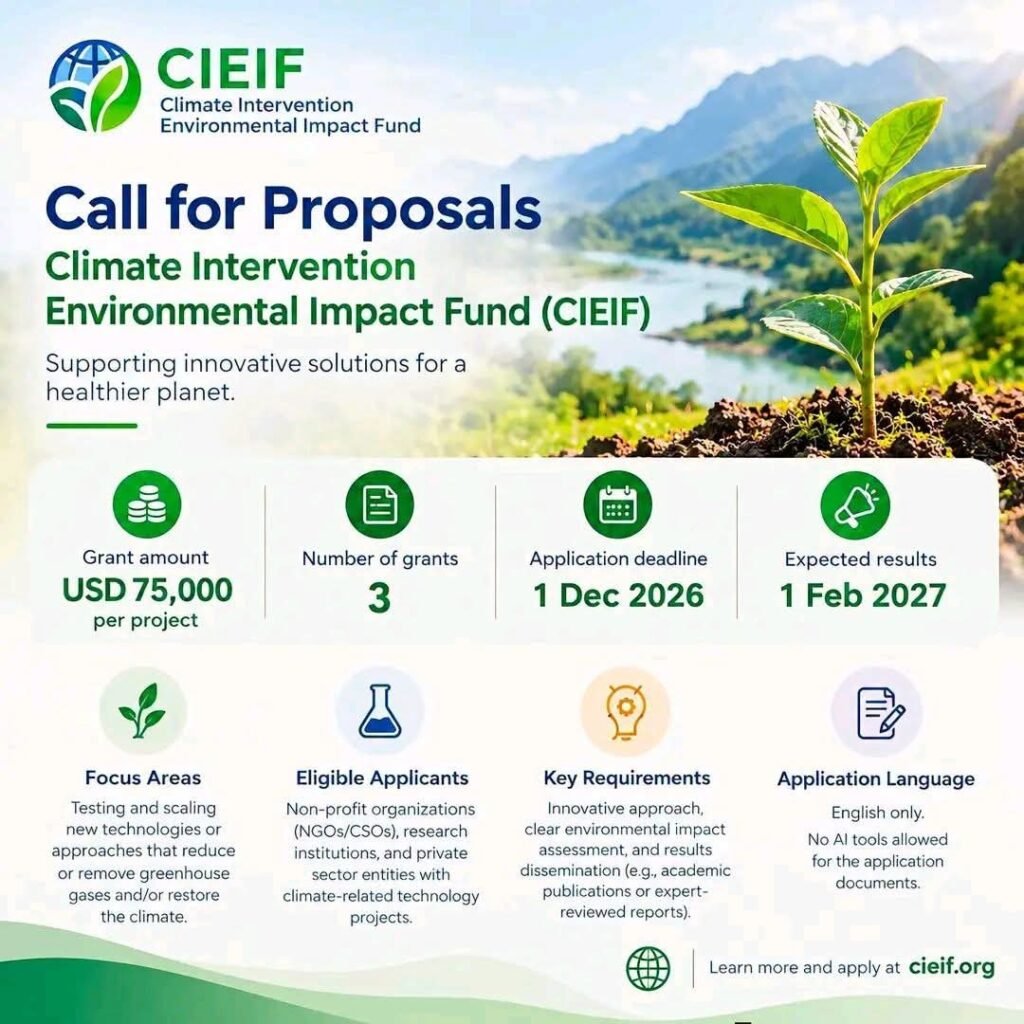
CIEIF Grants 2026 are now open for applications! The Climate Intervention Environmental Impact Fund (CIEIF) has announced an international funding opportunity for researchers, academic institutions, non-profit organizations, and eligible private-sector projects working on innovative climate intervention technologies.
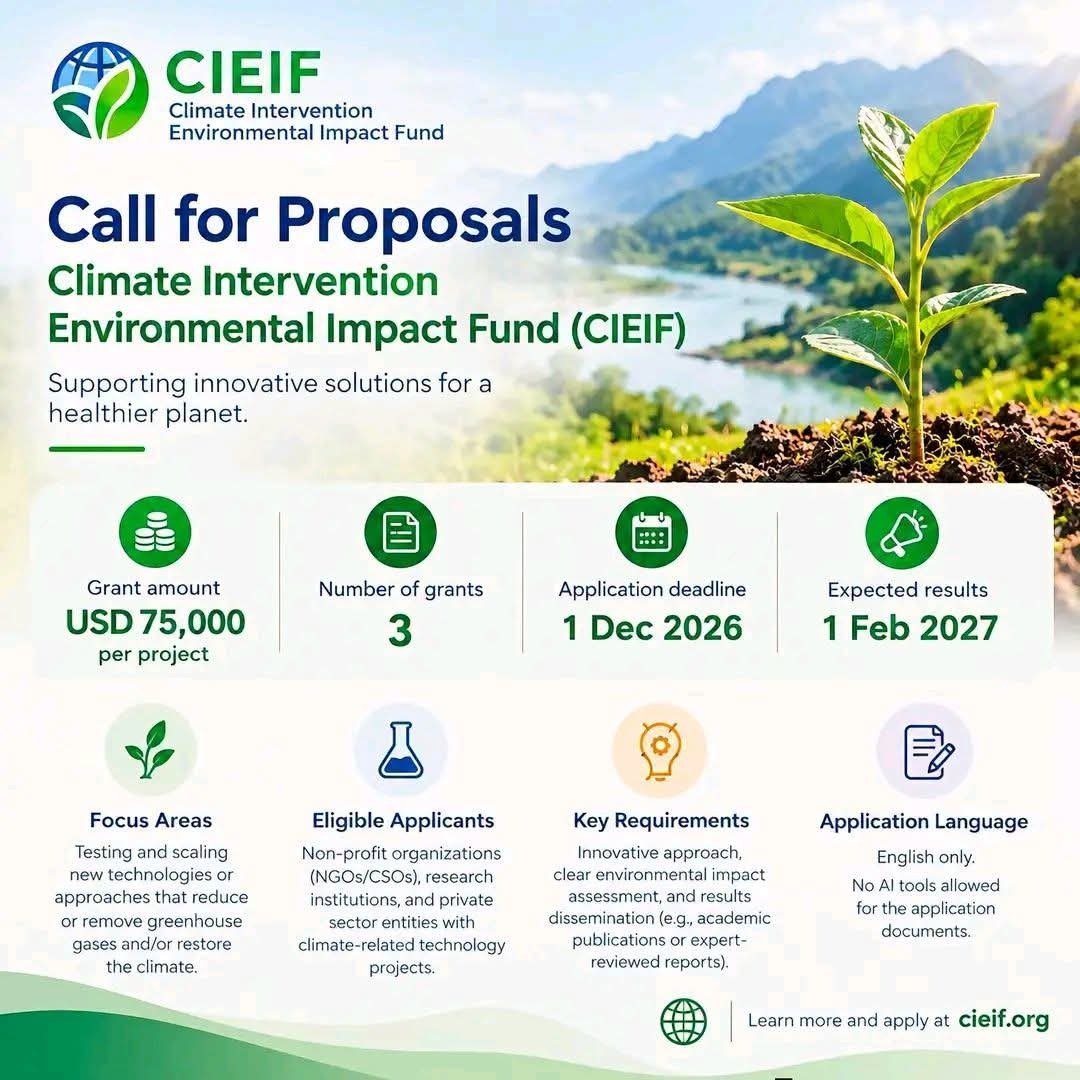
The fund is offering three grants of USD 75,000 each to support environmental impact assessments, predictive impact modeling, and stakeholder engagement associated with emerging climate intervention technologies.
Interested applicants from around the world can submit their proposals before the December 1, 2026 deadline. Funding decisions are expected to be announced by February 1, 2027.
This article explains the available funding, eligibility criteria, research priorities, application requirements, and submission process for the CIEIF Grants 2026.
CIEIF Grants 2026 – Key Details
| Grant Information | Details |
| Grant Name | Climate Intervention Environmental Impact Fund (CIEIF) |
| Funding Year | 2026 |
| Host Organization | CIEIF, USA |
| Grant Amount | USD 75,000 per project |
| Number of Grants | 3 |
| Total Available Funding | USD 225,000 |
| Eligible Countries | Worldwide |
| Application Deadline | December 1, 2026 |
| Expected Grant Decisions | February 1, 2027 |
| Application Language | English |
| Official Website | https://cieif.org/ |
What Is the Climate Intervention Environmental Impact Fund (CIEIF)?
The Climate Intervention Environmental Impact Fund (CIEIF) is an international funding initiative supporting innovative technologies and scientific approaches designed to address the causes and major global effects of climate change.
Its primary objective is to help researchers and organizations understand the potential environmental and social consequences of emerging climate intervention technologies before they are tested or scaled up.
Unlike conventional research grant programs, CIEIF focuses specifically on supporting independent environmental impact assessments, predictive modeling, and engagement with communities and stakeholders who may be affected by proposed climate interventions.
The program aims to encourage responsible scientific innovation while promoting environmental safety, transparency, and evidence-based decision-making.
CIEIF Grants 2026 Funding Amount
For the 2026 application round, CIEIF has announced three competitive grants worth USD 75,000 each, providing a combined funding opportunity of USD 225,000.
Selected applicants may receive financial support for:
- Environmental Impact Assessment (EIA) of proposed climate intervention field tests.
- Predictive environmental impact modeling.
- Engagement and consultation with potentially affected stakeholders.
- Independent expert assessments and related consultancy services.
The funding is not intended for general scientific research, technology construction, or the direct implementation of climate intervention projects.
Successful applicants will receive their funding in installments. The first installment, representing one-third of the grant, will be released after the required project scoping discussions. Remaining payments will be linked to agreed project milestones.
Research Areas Supported by CIEIF Grants 2026
CIEIF welcomes innovative climate intervention technologies with the potential to produce meaningful climate benefits at scale.
Examples of relevant areas include:
1. Carbon Dioxide Removal
Innovative approaches that remove atmospheric carbon dioxide and demonstrate the potential for long-term carbon storage may be considered.
2. Biochar and Enhanced Rock Weathering
Projects investigating the environmental impacts of biochar-based carbon removal and enhanced rock weathering technologies may qualify.
3. Methane Removal Technologies
Research initiatives exploring methods for removing atmospheric methane or capturing methane from agricultural and other sources may be relevant.
4. Agricultural Climate Interventions
Innovative agricultural technologies designed to address the underlying causes of global warming, including certain methane and nitrous oxide interventions, may be considered.
5. Ocean-Based Climate Interventions
Projects focused on marine carbon dioxide removal and other ocean-based climate restoration technologies may also be eligible.
6. Other Climate Restoration Technologies
Additional proposals may involve atmospheric greenhouse gas removal, black carbon mitigation, surface reflectivity interventions, and other approaches with measurable climate restoration potential.
Important: CIEIF does not fund ordinary climate adaptation, renewable energy, general sustainability, or conventional emissions-reduction projects. Direct Air Capture (DAC), Carbon Capture Utilization and Storage (CCUS), and stratospheric solar radiation management are also excluded.
Who Can Apply for CIEIF Grants 2026?
The funding opportunity is open internationally to eligible organizations proposing innovative climate intervention field tests.
Priority is generally given to:
- Universities and academic research institutions.
- Non-profit research organizations.
- Non-governmental organizations conducting relevant climate intervention research.
- Eligible private-sector organizations developing innovative climate technologies.
- International research partnerships working on climate intervention impact assessments.
Applications from institutions outside the United States are welcome. However, international proposals may receive higher priority if they have a US-based non-profit partner able to receive the grant.
Individuals, students applying independently, and government agencies are not eligible for direct funding.
Applicants must demonstrate that their proposed technology has a credible scientific basis and is sufficiently developed to justify a field test.
Key Application Requirements
Applicants must prepare a focused proposal showing how the USD 75,000 grant will support environmental impact analysis, predictive modeling, or stakeholder engagement.
The application should address the following essential aspects:
- Applicant Information: Complete contact details, institutional information, and professional biographies of project personnel.
- Project Description: Explanation of the proposed climate intervention technology, supporting scientific evidence, and field-testing plans.
- Innovation and Scalability: Description of what makes the technology innovative and how it could potentially be scaled to achieve meaningful climate benefits.
- Regulatory Requirements: Identification of relevant government permits, approvals, and regulatory considerations.
- Scientific Evidence: Details of previous research and publications supporting the proposed intervention.
- Independent Expertise: Identification of suitable independent consultants or consulting organizations.
- Environmental and Social Impacts: Assessment of possible environmental, economic, public health, safety, and social consequences.
- Use of Funding: Explanation of how the requested grant will support the eligible assessment and engagement activities.
- Stakeholder Engagement: Relevant plans for consultation with potentially affected communities, organizations, or authorities.
- Results and Dissemination: A commitment to publishing findings in a peer-reviewed journal or independently reviewed report.
Applicants must follow all ten questions in the official CIEIF guidelines when preparing their submissions.
How to Apply for CIEIF Grants 2026
Interested applicants should follow these steps:
Step 1: Visit the Official Website
Open the official Climate Intervention Environmental Impact Fund website at https://cieif.org/.
Step 2: Review Eligibility Criteria
Read the “What We Do” section carefully to confirm that the proposed climate intervention falls within CIEIF’s funding priorities.
Step 3: Study the Application Guidelines
Visit the official guidelines page and review all ten required application questions.
Step 4: Prepare the Research Proposal
Develop an English-language proposal explaining the intervention, its scientific foundation, potential impacts, proposed assessments, and anticipated outcomes.
The main application should not exceed 20 single-spaced pages using 12-point font. Relevant scientific publications and biographical materials may be included as supplementary documents.
Step 5: Contact CIEIF for Submission Instructions
Applicants should contact the fund manager using the official email address, info@CIEIF.org, to confirm the appropriate method for delivering their completed proposal.
Step 6: Submit Before the Deadline
Ensure that the complete application reaches CIEIF by December 1, 2026.
Important Policy on Artificial Intelligence
CIEIF expressly prohibits AI-generated cover letters and application documents. Applications identified as using AI may be rejected, and applicants may be barred from future funding rounds.
Applicants should prepare their official submissions independently and follow CIEIF’s requirements strictly.
CIEIF Grants 2026 Application Deadline
The last date to apply is December 1, 2026.
According to the official funding guidelines, decisions for the sixth round of grants are expected to be announced by February 1, 2027.
Since the program offers only three grants, prospective applicants are encouraged to review the requirements early and allow sufficient time to prepare a scientifically justified proposal.
Why Should Researchers Consider CIEIF Funding?
The CIEIF Grant 2026 provides an opportunity for research institutions and climate technology innovators to obtain specialized support for assessing emerging climate interventions.
In addition to financial assistance, the program emphasizes independent scientific evaluation, responsible field testing, stakeholder engagement, and public dissemination of research findings.
For universities and organizations developing innovative carbon removal, methane removal, or related climate intervention technologies, the grant may help address important environmental and social questions before wider testing or deployment.
Frequently Asked Questions (FAQs)
1. What is the CIEIF Grants 2026 funding amount?
CIEIF offers three grants of USD 75,000 each, with a total announced funding allocation of USD 225,000.
2. What is the deadline for CIEIF Grants 2026?
The application deadline is December 1, 2026.
3. Can Pakistani researchers apply for CIEIF Grants 2026?
Yes. Eligible research institutions and organizations from Pakistan may apply because the funding opportunity is international. However, proposals must meet CIEIF’s specific climate intervention eligibility requirements.
4. Are university researchers eligible?
Yes. Academic institutions are among the priority applicant categories, provided the project fulfills the program’s objectives.
5. Can individual students apply?
No. CIEIF does not provide direct grants to students or individuals.
6. Does CIEIF fund general climate change research?
No. The fund is specifically designed for environmental impact analysis, predictive modeling, and stakeholder engagement associated with innovative climate intervention field tests.
7. Can applicants use AI tools to prepare their proposals?
No. CIEIF prohibits AI use in grant applications and cover letters.
8. When will successful applicants be announced?
Grant decisions are expected by February 1, 2027.
Final Words
The CIEIF Grants 2026 offer a valuable international funding opportunity for qualified researchers, academic institutions, and organizations developing innovative climate intervention technologies.
With three grants of USD 75,000 available, the program aims to support independent impact assessments, responsible field-testing preparations, and scientific understanding of emerging climate restoration approaches.
Eligible applicants should review the official guidelines carefully and submit their applications before December 1, 2026.
Official Website: https://cieif.org/
Application Guidelines: https://cieif.org/guidelines-for-grant-applicants/
Eligibility Details: https://cieif.org/what-we-do/
Official Contact Email: info@CIEIF.org
Disclaimer: This article is published for informational purposes only. It is not affiliated with CIEIF. Applicants should consult the official funding website for the latest requirements and submission instructions.
You can also apply for Sindh Research Support Programme (SRSP) 2026-27 – Research Grant, Eligibility, Application Form & Last Date https://agriculture111.com/sindh-research-support-programme-srsp-2026-27-research-grant-eligibility-application-form-last-date/