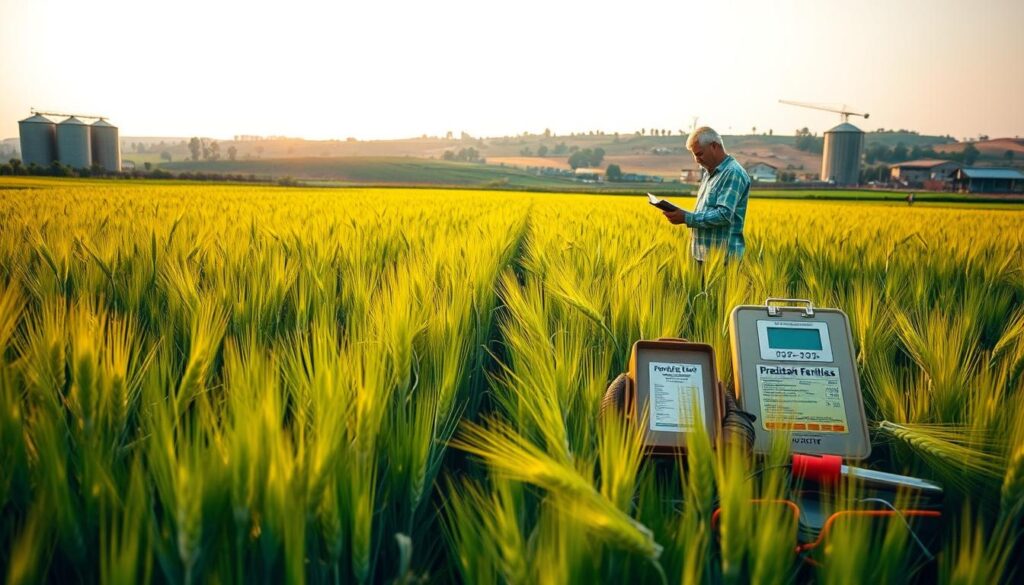
Pakistan’s agriculture is key to its economy, with wheat being a major crop. Yet, wheat yields in Pakistan are significantly lower than the global average. This is mainly because of poor fertilization practices.
A well-thought-out wheat fertilizer schedule can greatly boost crop yields and quality. Getting the right mix of NPK (Nitrogen, Phosphorus, Potassium) is essential for growing healthy wheat.
Pakistani farmers deal with many hurdles, like soil degradation and a lack of knowledge on fertilizers. By using the correct NPK dose and fertilization plan, farmers can increase their wheat output. This helps ensure food security and boosts the economy.
Key Takeaways
- Proper wheat fertilization can significantly increase crop yields.
- NPK balance is crucial for healthy wheat production.
- Pakistani farmers face challenges like soil degradation.
- Adopting the right fertilizer schedule can improve food security.
- Economic stability can be achieved through enhanced wheat production.
The Current State of Wheat Farming in Pakistan
Pakistani wheat farmers are facing big problems like climate changes and water shortages. These issues make it hard for them to get the best wheat yields.
Key Challenges Facing Pakistani Wheat Farmers
The wheat farming community in Pakistan is dealing with big issues. Climate variability is a major problem, as it changes the fertilization needs of wheat crops.
Climate Variability Impact on Fertilization Needs
Changes in weather patterns due to climate variability mean farmers need to adjust their fertilizers. They must change how they apply fertilizers to meet their crops’ new needs.
Water Availability Concerns
Water scarcity is also a big challenge. Insufficient water can make fertilizers less effective, which lowers wheat yields.
The Impact of Proper Fertilization on Wheat Yields
Using the right fertilizers is key to getting the most from wheat crops. Research in Pakistan has shown that the right fertilizer use can really boost crop production.
Statistical Evidence from Pakistani Research
- A study by the Pakistan Agricultural Research Council found that balanced fertilization increased wheat yields by up to 25%.
- Another research project in Punjab province showed that proper NPK application led to a 30% increase in wheat production.
These numbers highlight how important proper fertilization is for better wheat yields. By using the right fertilizer schedule, Pakistani wheat farmers can beat some of their challenges and increase their output.
Understanding Your Soil Before Fertilization
To get the most from your wheat, you need to know your soil. Soils vary in nutrients and pH, affecting wheat growth.
The Importance of Soil Testing
Soil testing is key for fertilizing right. It tells you about nutrients, pH, and more. This info helps you choose the right fertilizers.
Where to Get Soil Tests in Pakistan
In Pakistan, you can get soil tests from many places. The Pakistan Agricultural Research Council (PARC) and provincial departments offer them. Private labs and universities also provide this service.
Interpreting Soil Test Results for Wheat Cultivation
Understanding soil test results is important. Look at nitrogen, phosphorus, potassium, and pH levels. For wheat, aim for a pH of 6.0 to 7.0.
Regional Soil Variations Across Pakistan
Pakistan’s varied landscapes mean different soils. Punjab’s plains are fertile, while Balochistan’s is dry.
Soil pH Considerations for Different Regions
Soil pH changes by region in Pakistan. Sindh’s soils are often alkaline, while Khyber Pakhtunkhwa’s are acidic. Knowing this helps with fertilizers.
| Region | Typical Soil pH | Fertilizer Consideration |
|---|---|---|
| Punjab | 6.5-7.5 | Balanced NPK |
| Sindh | 7.0-8.0 | Micronutrient supplementation |
| Khyber Pakhtunkhwa | 5.5-7.0 | Soil conditioning for acidity |
Essential Nutrients for Optimal Wheat Growth
Knowing what wheat crops need is key to getting the best yields in Pakistan. Wheat, a main crop, needs a mix of nutrients to grow well and produce lots of grain.
Macronutrients vs. Micronutrients for Wheat
Wheat needs both big and small nutrients to grow right. Big nutrients, like nitrogen, phosphorus, and potassium, are needed in big amounts. They help with leaf growth, root development, and making grain.
Critical Nutrient Ratios for Pakistani Wheat Varieties
The right mix of nitrogen, phosphorus, and potassium for wheat in Pakistan changes based on soil and crop type. A balanced fertilizer with a 4:2:1 or 3:2:1 NPK ratio is often suggested. Below is a table showing what wheat crops in different parts of Pakistan usually need.
| Region | N (kg/acre) | P (kg/acre) | K (kg/acre) |
|---|---|---|---|
| Punjab | 120-150 | 60-80 | 30-40 |
| Sindh | 100-130 | 50-70 | 25-35 |
| Khyber Pakhtunkhwa | 90-120 | 45-65 | 20-30 |
Signs of Nutrient Deficiency in Wheat Crops
Not getting enough nutrients can hurt wheat yields. Spotting these problems early is important for fixing them.
Visual Identification Guide
Looking at the plants can show if they’re missing nutrients. For example, too little nitrogen makes older leaves turn yellow. Too little phosphorus makes plants grow short and leaves dark green.
By knowing what wheat needs and spotting nutrient problems, farmers in Pakistan can help their crops grow better.
Best Wheat Fertilizer Schedule in Pakistan (2025 Updated)
To boost wheat yields in Pakistan, a detailed fertilizer plan is key for 2025. A well-timed fertilizer application is vital. It ensures wheat plants get the right nutrients at the right time.
Pre-Sowing Fertilizer Application
Applying the right fertilizer before sowing is crucial. This initial step is called the basal dose.
Basal Dose Recommendations
The basal dose includes phosphorus and potassium fertilizers like DAP and MOP. For most Pakistani soils, 1-2 bags (50 kg each) of DAP per acre is advised. Potassium needs vary by soil, but usually, 1 bag of MOP per acre is enough.
| Fertilizer Type | Recommended Dose per Acre |
|---|---|
| DAP | 1-2 bags (50 kg each) |
| MOP | 1 bag (50 kg) |
First Application (Tillering Stage)
The first fertilizer application is vital during the tillering stage, 20-25 days after germination. This is when wheat plants start growing more shoots.
Timing and Weather Considerations
Apply nitrogen-based fertilizers like urea at this stage. The dose is usually 1-1.5 bags (50 kg each) per acre. Adjustments depend on soil nitrogen and previous crops.
Second Application (Jointing Stage)
At the jointing stage, about 45-50 days after sowing, wheat needs more nitrogen for growth.
Apply urea again, at the same rate as the first time. This keeps the crop growing well.
Final Application (Heading Stage)
Adjustments for Late-Season Conditions
The final fertilizer application is in the heading stage, 60-70 days after sowing. A final urea dose might be needed, based on crop and weather conditions.
By sticking to this fertilizer schedule, Pakistani farmers can greatly increase their yields. This helps ensure the country’s food security.
NPK Fertilizers: Dosage and Application Techniques
For Pakistani wheat farmers, knowing how to use NPK fertilizers is key. These fertilizers have nitrogen, phosphorus, and potassium. They help wheat grow well and increase yields.
Recommended NPK Ratios for Pakistani Wheat Varieties
The best NPK ratio for wheat in Pakistan depends on soil and wheat type. A balanced ratio like 20:20:0 or 17:17:17 is usually suggested for wheat.
Variations for Irrigated vs. Rainfed Wheat
Irrigated wheat often gets more nitrogen because it has more water. This helps it grow stronger. Rainfed wheat, however, might need different NPK ratios because of changing rain amounts.
Application Methods for Maximum Efficiency
There are two main ways to apply NPK fertilizers: broadcasting and band placement. Broadcasting spreads the fertilizer over the soil. Band placement puts it near the roots. The choice depends on soil, crop stage, and tools available.
Adjusting NPK Doses Based on Soil Conditions
Soil testing is vital for finding the right NPK doses. Soil pH, nutrient levels, and organic matter affect fertilizer needs. Adjusting doses based on soil helps farmers use fertilizers better and save resources.
By using the right NPK fertilizer strategies, Pakistani wheat farmers can boost their yields. This helps ensure the country’s food security.
Urea Application Guide for Wheat Farmers
Wheat farmers in Pakistan can boost their crop’s growth by learning the best ways to use urea. Urea is a key nitrogen fertilizer that greatly affects wheat yields.
Optimal Timing for Urea Application
When to apply urea is key for its best results. Urea should be used when the wheat is growing fast.
Weather Considerations for Urea Efficiency
Weather affects how well urea works. Urea doesn’t work as well in dry weather because it needs moisture to break down. It’s best to apply urea before rain or irrigation to help the wheat absorb more nitrogen.
Calculating the Right Urea Dose per Acre
Farmers need to figure out the right amount of urea based on their soil and the wheat’s needs. A simple formula helps:
- Urea dose (kg/acre) = (Recommended nitrogen dose – Soil nitrogen supply) / Nitrogen content in urea
For example, if the wheat needs 120 kg N per acre and the soil has 20 kg N, and urea has 46% nitrogen:
- Urea dose = (120 – 20) / 0.46 = 217.4 kg/acre
Formulas and Practical Examples
Farmers can tweak this formula for their specific situation. They should also think about the cost of urea and how much more they might get from it when deciding how much to apply.
Split Application vs. Single Application
Split application means spreading out the urea over different growth stages. Single application means using it all at once.
| Application Method | Advantages | Disadvantages |
|---|---|---|
| Split Application | Improves how nitrogen is used, better crop response | More labor costs, more complex |
| Single Application | Less labor costs, easier to manage | Nitrogen loss possible, less efficient |
Cost-Benefit Analysis
Doing a cost-benefit analysis can help farmers choose between split and single application. Split application might give better yields, but the extra cost and effort need to be weighed.
DAP Fertilizer: When and How to Apply
DAP fertilizer is vital for wheat growth. Knowing how to use it is essential for high yields. In Pakistan, Diammonium phosphate (DAP) is a top choice for wheat farming.
The Role of DAP in Wheat Development
DAP is packed with phosphorus and nitrogen, key for wheat. Phosphorus is especially important for root growth and plant maturity. Without enough phosphorus, plants can grow weak and yield less.
Best Practices for DAP Application in Pakistani Conditions
In Pakistan, the best time to apply DAP is when you plant wheat. You’ll need 2-3 bags per acre, based on soil type. Soil testing is essential to figure out the exact amount needed.
Application Methods to Maximize Phosphorus Availability
To get the most out of phosphorus, apply DAP carefully. Avoid direct soil contact to prevent phosphorus from being locked up. Using band placement or mixing with organic matter helps phosphorus absorption.
Combining DAP with Other Fertilizers
DAP can be mixed with urea and potash. Compatibility is crucial when blending fertilizers. Always follow the guidelines to prevent harmful reactions.
Compatibility and Mixing Guidelines
When mixing DAP with other fertilizers, make sure the blend is even. Apply it right away. Some fertilizers don’t mix well, so check their chemical makeup before mixing.
Cost-Effective Fertilization Strategies
Cost-effective fertilization is key for successful wheat farming in Pakistan. It requires careful planning and smart decisions. Farmers need to plan their budgets for fertilizers and know about government subsidies.
Budget Planning for Seasonal Fertilizer Needs
Effective budget planning is crucial for managing fertilizer costs. Farmers should first check their finances and plan for the next season’s fertilizer needs.
Current Market Prices and Trends
Knowing the current market prices and trends helps farmers make smart fertilizer choices. Buying in bulk during off-peak seasons can save a lot of money.
| Fertilizer Type | Average Price (PKR/kg) | Recommended Dosage (kg/acre) |
|---|---|---|
| Urea | 50 | 100 |
| DAP | 120 | 50 |
| NPK | 80 | 75 |
Government Subsidies and Support Programs
The Pakistani government has subsidies and support for farmers. These include subsidies on fertilizers, help with soil testing, and training on fertilization.
Balancing Cost vs. Yield Potential
Farmers need to balance cost and yield. They should choose the right fertilizers and apply them at the best time. Their fertilization strategy should match their farming goals.
Return on Investment Calculations
ROI calculations help farmers see if their fertilization is worth it. By comparing costs and yield increases, they can make better choices.
Sustainable and Organic Fertilization Options
Pakistani wheat farmers are looking ahead to 2025. They are turning to sustainable and organic fertilizers to boost crop yields and cut down on environmental harm. This method not only makes the soil healthier but also supports a greener farming practice.
Integrating Organic Matter into Your Fertilization Plan
Adding organic matter to your fertilization plan is key for sustainable wheat farming. Materials like farmyard manure and compost can make the soil better, hold more water, and give crops the nutrients they need.
Farmyard Manure and Compost Application
Farmyard manure and compost are packed with nutrients and good microbes. Using 5-10 tons of these per acre before planting can make the soil more fertile and help wheat grow well.
Green Manuring Practices for Wheat
Green manuring means adding leguminous crops to the rotation to add nitrogen to the soil. Crops like Securigera varia or Melilotus officinalis can be grown between wheat cycles. They add organic matter and boost soil health.
Reducing Environmental Impact While Maintaining Yields
Farmers can lessen environmental harm by using climate-smart fertilizers. This includes slow-release fertilizers, precise farming methods, and adding organic amendments to their fertilization plans.
Climate-Smart Fertilization Approaches
Climate-smart fertilization means adjusting fertilizer use based on crop and soil needs, weather, and climate changes. It includes splitting fertilizer applications, using nitrification inhibitors, and applying fertilizers at the best time for maximum absorption.
| Fertilization Method | Benefits | Application Rate |
|---|---|---|
| Farmyard Manure | Improves soil structure, increases water retention | 5-10 tons/acre |
| Compost | Rich in nutrients, beneficial microorganisms | 5-10 tons/acre |
| Green Manuring | Enriches soil with nitrogen, improves soil health | Depends on crop selection |
Conclusion: Maximizing Your Wheat Yield Through Proper Fertilization
To get the most out of wheat in Pakistan, you need a good fertilizer plan. Knowing your soil type and picking the right fertilizers are key. Applying them at the right times in wheat growth boosts your crop’s yield.
A good fertilization plan does more than just increase wheat yield. It also makes sure you use resources wisely. By following the advice from earlier, farmers can create a fertilizer plan that fits their wheat’s needs. This leads to healthier plants and more crops.
Creating a fertilizer plan that matches your wheat’s needs is essential for the best results. With the right fertilization, Pakistani farmers can improve their farming and help feed the country.