Choosing the right tractor is key for good farming, no matter the farm size. The right tractor boosts your work’s efficiency and profit.
The size and type of tractor you need depends on several things. These include your farm’s size, the crops you grow, and the land’s terrain. Knowing these helps you make a smart choice.
Key Takeaways
- Farm size plays a crucial role in determining the right tractor.
- The type of agricultural equipment needed varies with farm size.
- Tractor selection impacts farming efficiency and productivity.
- Understanding your farm’s specific needs is essential.
- The right tractor can improve profitability.
Understanding Farm Sizes and Tractor Requirements
Farm size is key in picking the right tractor. The USDA groups farms by income, but for tractors, it’s about acres and farming type.
Defining Small, Medium, and Large Farms in the US
Small farms are under 50 acres. Medium farms are 50 to 500 acres. Large farms are over 500 acres. “The farm size decides the equipment needed,” experts say.
How Farm Size Affects Tractor Selection
The size of your farm affects the tractor you need. Small farms need easy-to-move tractors with less power. Big farms need strong tractors for heavy work.
Matching Horsepower to Acreage
Choosing the right tractor horsepower is important. For small farms, look for 20-25 horsepower. Medium farms need 50-100 horsepower. Large farms need over 150 horsepower.
As “the right horsepower ensures optimal performance and fuel efficiency”, experts say. Knowing your farm size and tractor needs helps boost productivity and cut costs.
Key Factors to Consider When Choosing a Tractor
Choosing a tractor is a big decision for your farm. It’s important to know what your farm needs. With many options, understanding your farm’s needs is key.
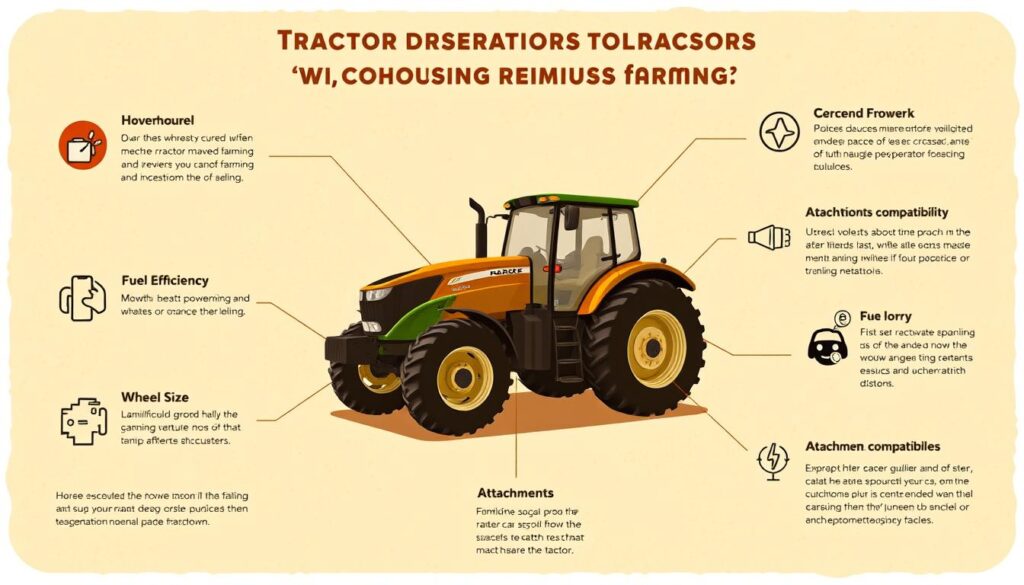
Horsepower and Engine Specifications
The horsepower of a tractor is very important. Higher horsepower tractors are best for big farms or heavy tasks like plowing. Think about your farm’s needs and budget when looking at engine specs like fuel efficiency and type.
Transmission Types: Hydrostatic vs. Gear
Tractors have different transmissions, like hydrostatic and gear. Hydrostatic transmissions are great for precise tasks, like loader work, because they offer smooth speed control. Gear transmissions are better for heavy-duty tasks because they have more speeds.
Hydraulic Capacity and Lift Capabilities
The hydraulic system is key for attachments like loaders and mowers. Hydraulic capacity is about how well the system works with these attachments. Lift capability is also important, as it shows how much weight the tractor can lift.
PTO Options and Compatibility
The Power Take-Off (PTO) system powers implements like mowers. It’s important that your tractor’s PTO matches your equipment. Check the PTO’s horsepower rating to make sure it fits your needs.
Best Tractors for Small Farmers, Large Farmers, and Medium Operations
Farmers in the United States need tractors that match their farm size. Whether it’s small, medium, or large, the right tractor boosts productivity and efficiency.
Overview of Leading Tractor Manufacturers
Several top manufacturers make high-quality tractors. John Deere, Kubota, and Case IH are leaders in the field. They offer tractors for all farm sizes.
Kubota is famous for its compact tractors, perfect for small farms. John Deere has models for both small and large farms. Case IH provides high-horsepower tractors for big farms.
Price Range Expectations by Farm Size
Tractor prices vary by farm size and needs. Here’s what farmers can expect to pay:
| Farm Size | Tractor Price Range |
|---|---|
| Small Farms (Under 50 Acres) | $15,000 – $30,000 |
| Medium Farms (50-500 Acres) | $30,000 – $80,000 |
| Large Farms (500+ Acres) | $80,000 – $150,000+ |
New vs. Used Tractor Considerations
Farmers must choose between new or used tractors. New tractors have the latest tech and warranty but cost more. Used tractors are cheaper but need more upkeep.
Small farmers might find used tractors more affordable. Large farms might prefer new tractors for their advanced features. It’s key to consider what’s best for your farm’s needs and budget.
Top Tractors for Small Farms (Under50 Acres)
Tractors for small farms under 50 acres must be efficient, reliable, and easy to handle. These farms need versatile tractors for tasks like plowing, tilling, hauling, and mowing.
Kubota B2601 and B3350
Kubota’s B2601 and B3350 are known for their strong performance and durability. The B2601 has a 24.8 horsepower engine. The B3350 has 33.5 horsepower, great for slightly bigger small farms. Both have a hydrostatic transmission for smooth use and a strong hydraulic system for various attachments.
John Deere 1025R and 2032R
John Deere’s 1025R and 2032R are favorites for small farmers. The 1025R has a 24.2 horsepower engine, perfect for light tasks. The 2032R has 32 horsepower, ideal for tougher jobs. Both are easy to use and work with many John Deere attachments.
Mahindra eMax 20S HST and 25L HST
Mahindra’s eMax series, like the 20S HST and 25L HST, is known for being fuel-efficient and powerful. The 20S HST has a 19.4 horsepower engine. The 25L HST has 24.7 horsepower. They have a hydrostatic transmission for easy use and come with a long warranty.
Best Applications for Sub-Compact Models
Sub-compact tractors are great for small farms with limited land. They’re perfect for:
- Mowing and trimming
- Tilling and cultivating
- Hauling small loads
- Plowing snow or light materials
As
“The right tractor can make all the difference in the productivity and efficiency of a small farm.”
, picking a tractor that meets your needs is key.
Best Compact Tractors for Small to Medium Operations
Compact tractors from New Holland, Massey Ferguson, and Kioti are perfect for small to medium farms. They offer power, versatility, and easy maneuverability for various farm tasks.
New Holland Workmaster25S and 35
New Holland’s Workmaster series is known for its durability and performance. The Workmaster25S and 35 models are compact tractors with impressive horsepower and hydraulic capacity. They are great for plowing and loader work.
The Workmaster25S has a 25 horsepower engine, and the Workmaster35 has 35 horsepower. Both have a hydrostatic transmission for smooth operation and ease of use.
Massey Ferguson 1825E and 1840E
Massey Ferguson’s compact tractors, like the 1825E and 1840E, are made with the farmer’s needs in mind. They offer a comfortable operating experience and come with a hydrostatic transmission and a robust hydraulic system.
The 1825E is a compact tractor with 25 horsepower, perfect for small farms or landscaping. The 1840E, with its 40 horsepower engine, can handle bigger tasks like loader work and plowing.
Kioti CK2610 and CK3510
Kioti’s compact tractors, including the CK2610 and CK3510, are known for their reliability and versatility. They are designed to efficiently perform a variety of farming tasks.
The CK2610 has a 26 horsepower engine, and the CK3510 has a 35 horsepower engine, both with excellent hydraulic capacity. Kioti’s compact tractors are also praised for their ease of maintenance and operator comfort.
Versatility and Attachment Options
Compact tractors are versatile due to the variety of attachments available. Attachments like loaders, backhoes, mowers, and tillers can greatly enhance your tractor’s functionality.
“The right attachment can transform your compact tractor into a multi-purpose machine, capable of handling a wide range of tasks on your farm or property.”
When choosing a compact tractor, consider the availability and compatibility of attachments. This can greatly impact the tractor’s overall utility and value.
Ideal Tractors for Medium-Sized Farms (50-500 Acres)
Tractors for medium-sized farms must be strong, efficient, and versatile. They handle various tasks on farms of 50 to 500 acres. These tractors need to work well in both large areas and tight spaces.
John Deere 5075E and 5100E
The John Deere 5075E and 5100E are great for medium-sized farms. They have power and maneuverability. Their engines are strong, and their transmissions are smooth.
- The 5075E has 75 horsepower, good for smaller farms.
- The 5100E has 100 horsepower, better for larger farms.
Case IH Farmall 75A and 100A
Case IH Farmall tractors are durable and perform well. The Farmall 75A and 100A meet medium-sized farm needs. They have:
- Advanced hydraulic systems for efficient implement handling.
- Comfortable operator stations for less fatigue during long hours.
Kubota M6060 and M7060
Kubota’s M6060 and M7060 tractors are versatile and reliable. They have:
- Powerful engines with high torque for tough tasks.
- Advanced transmission systems for smooth power delivery.
Balancing Power and Maneuverability
For medium-sized farms, finding the right balance is key. Tractors must be strong for big tasks but also easy to move in small areas. The tractors mentioned above strike this balance, making them perfect for farms of 50 to 500 acres.
Heavy-Duty Tractors for Large Farm Operations (500+ Acres)
Choosing the right heavy-duty tractor is key for large farms. These tractors must handle tough tasks well. They make farming more efficient.
John Deere, Case IH, and New Holland lead in heavy-duty tractors. They offer high performance and reliability. These tractors also have advanced features to boost farming productivity.
John Deere 8R310 and 8R370
The John Deere 8R series tractors are powerful and tech-savvy. The 8R310 and 8R370 models have:
- High horsepower for tough tasks
- Advanced transmissions for smooth use
- More hydraulic power for heavy lifting
John Deere says, “The 8R series tractors are made for high productivity and efficiency in big farming.”
Case IH Magnum 250 and 310
Case IH Magnum tractors are known for their strength and flexibility. The Magnum 250 and 310 models have:
- Strong engines with lots of torque
- Smart fuel systems for better efficiency
- Comfortable seats to reduce tiredness
New Holland T8.380 and T8.435
New Holland’s T8 series tractors are built for big farms. They offer:
- Powerful engines with clean emissions
- Smart transmissions for top performance
- Advanced hydraulics for precise control
“The T8 series tractors from New Holland are made for the power and efficiency big farms need.”
High-Capacity Features for Commercial Farming
These heavy-duty tractors have key features for commercial farming. They include:
| Tractor Model | Horsepower | Hydraulic Capacity |
|---|---|---|
| John Deere 8R310 | 310 HP | 24 GPM |
| Case IH Magnum 250 | 250 HP | 22 GPM |
| New Holland T8.380 | 380 HP | 160 lpm |
These features help farmers do big tasks efficiently. They are crucial for farms over 500 acres.
Technology and Smart Farming Features in Modern Tractors
Today’s tractors come with advanced tech like GPS, telematics, and automation. These changes are making farming more efficient and productive.
GPS and Precision Agriculture Systems
GPS helps farmers navigate and control their land better. It lets them grow more crops and waste less. Precision systems, linked to GPS, give detailed info on soil, moisture, and crop health. This helps farmers make better choices.
Telematics and Remote Monitoring
Telematics lets farmers check on their tractors from afar. They can see where the tractor is, how much fuel it’s using, and when it needs maintenance. This info helps farmers use their tractors better and cut down on downtime.
Automation Features Worth the Investment
Automation, like self-steering and section control, makes farming more precise and less tiring. These tools are especially useful for big farms. They can greatly improve how much is produced and how efficiently.
Using these smart farming tools, farmers can grow more, spend less, and farm better for the planet.
Specialty Tractors for Specific Farming Applications
Specialty tractors are made for different farming needs, like orchards and row crops. They are built to work best in certain places.
Orchard and Vineyard Models
The Kubota M5N and John Deere 5GN series are great for orchards and vineyards. They are small and easy to move, perfect for tight spaces. The Kubota M5N is narrow to avoid damaging crops. The John Deere 5GN has the latest tech for precise farming.
Row Crop Tractors
For row crops, the Case IH Steiger and New Holland T7 are top picks. They have lots of power and are very efficient. They come with advanced systems for heavy work in big fields.
Livestock Operation Tractors
The Massey Ferguson 4700 Series is great for livestock. They are versatile and reliable, with many attachments for tasks like feeding. Their strong build is perfect for daily use in livestock farming.
Choosing the right specialty tractor can really improve a farm’s work and results.
Budget-Friendly Tractor Options for Each Farm Size
Affordable tractors are key for small, medium, and large farms. Finding a tractor that fits your budget can be tough. But, there are many options that offer great value.
Affordable Small Farm Tractors: LS MT225 and Yanmar SA Series
For small farms, the LS MT225 and Yanmar SA Series are top picks. The LS MT225 is versatile and reliable, perfect for small areas. The Yanmar SA Series is long-lasting and easy to use, great for everyday tasks.
Cost-Effective Medium Farm Options: TYM T654 and Branson 5220C
Medium farms can choose the TYM T654 and Branson 5220C. These tractors offer power and affordability. The TYM T654 has advanced features for better productivity. The Branson 5220C is known for its fuel efficiency and strong performance.
Value Picks for Large Operations: Used John Deere 7R and Case IH Puma
Large farms can look at used tractors like the John Deere 7R Series or Case IH Puma. These tractors are highly performing and long-lasting. Buying used can save money without sacrificing power or reliability.
When picking a tractor, think about horsepower, transmission, and hydraulic capacity. This ensures it fits your farm’s needs. Choosing a budget-friendly tractor lets farmers spend more on other important areas.
Essential Attachments and Implements for Farm Tractors
The right implements can make a big difference on farms. It’s important to choose the right attachments to boost productivity and efficiency.
Must-Have Attachments for Small Farms
Small farms need attachments like rotary cutters, front-end loaders, and box blades. These tools help with land management and basic tasks.
Essential Implements for Medium Operations
Medium-sized farms should consider attachments like backhoes, post-hole diggers, and mowers. These tools add versatility and support bigger farming tasks.
Critical Equipment for Large Farm Productivity
Large farms need heavy-duty attachments such as plows, cultivators, and grain carts. These are key for managing big areas efficiently.
| Farm Size | Recommended Attachments |
|---|---|
| Small Farms | Rotary cutters, front-end loaders |
| Medium Farms | Backhoes, post-hole diggers, mowers |
| Large Farms | Plows, cultivators, grain carts |
Conclusion
Choosing the right tractor for your farm is very important. It helps make your farm more productive. Different farm sizes need different tractors.
Whether you have a small, medium, or large farm, knowing what you need is crucial. This helps you pick the best tractor for your farm.
The right tractor and attachments can make your farm work better. Brands like Kubota, John Deere, New Holland, and Case IH offer many models. They fit different farm sizes and needs.
When picking a tractor, think about horsepower, transmission type, and hydraulic capacity. These things help your tractor do its job well. Adding technology and smart farming features can also increase productivity.
In the end, the goal is to make your farm more productive without spending too much or harming the environment. By picking the right tractor, you can achieve this. This ensures your farm runs well.